
Why Customer Feedback Keeps Getting Misrouted — And the Agentic AI Triage System that Finally Fixes It
We investigated why support teams consistently misread frustrated customers from different cultural backgrounds. The answer wasn't better training — it was better ticketing.
We investigated why support teams consistently misread frustrated customers from different cultural backgrounds. The answer wasn't better training — it was better ticketing.
The Investigation: A Pattern Nobody Was Tracking
It started with a quarterly review of escalation rates. Our APAC support team was escalating 40% of customer complaints to senior management — well above the global average of 22%.
Were the complaints more severe? No. The product issues were comparable across regions.
Were the support staff undertrained? No. Their technical resolution rates were actually above average.
So why were so many tickets being kicked upstairs?
We pulled 200 random escalated tickets from the quarter and read every one. And we found the pattern:
The support team was misinterpreting cultural communication styles as problem severity.
A Japanese customer writing "I am somewhat disappointed with the experience" was being triaged as low-priority — when in that cultural context, "somewhat disappointed" often signals deep frustration. The indirect language was being read literally.
Conversely, an Australian customer writing "This is absolutely unacceptable!" was being flagged as critical — when the direct, expressive communication style didn't necessarily indicate a higher severity issue than the Japanese customer's understated feedback.
The support team wasn't failing. The triage system was culturally blind.
Get immediate access to the full JSON schema for this workflow.
The Finding: Sentiment Analysis Isn't Enough
Most AI-powered support tools run sentiment analysis: positive, negative, neutral. Simple.
But sentiment analysis measures the words, not the intent behind the words. When cultural communication norms vary dramatically — as they do across Asia-Pacific — word-level sentiment scoring produces systematically biased results:
| Customer Statement | Standard Sentiment Score | Cultural Context | Actual Severity |
|---|---|---|---|
| "I am somewhat disappointed" | 🟡 Mild negative | Japanese indirect communication norm | 🔴 High — customer is deeply frustrated |
| "This is ABSOLUTELY TERRIBLE" | 🔴 Extreme negative | Australian expressive norm | 🟡 Moderate — customer is annoyed but recoverable |
| "I trust your team will resolve this" | 🟢 Positive | Malaysian high-context deference | 🟡 Moderate — customer expects action despite polite framing |
| "I will wait for your response" | 🟢 Neutral | Indonesian patience norm | ⚠️ Warning — customer may be signaling they're about to escalate |
The mismatch is systematic, not random. And no amount of support-team training can fix it at scale — you'd need every agent to be an expert in cross-cultural pragmatics.
But an AI agent can be.
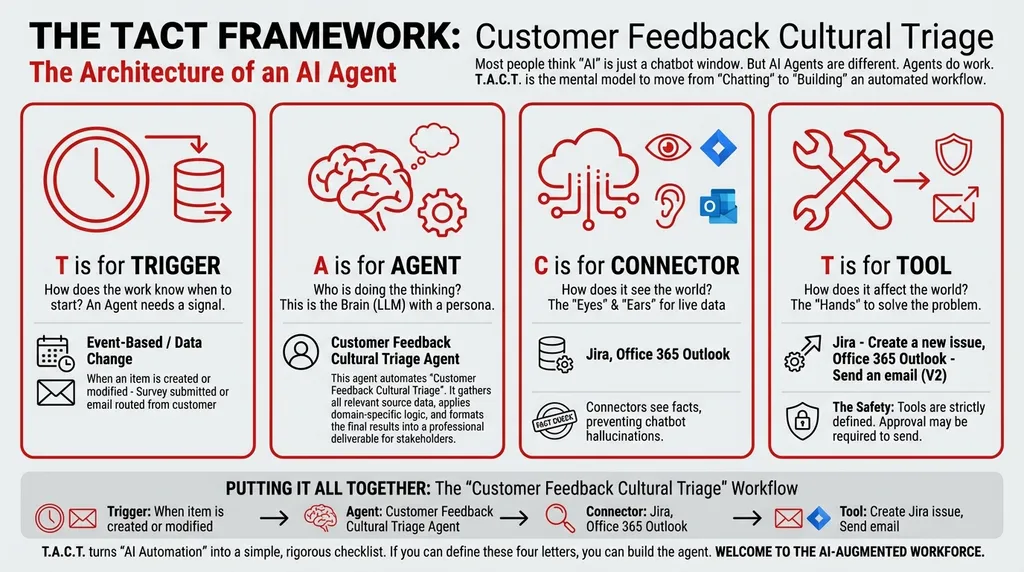
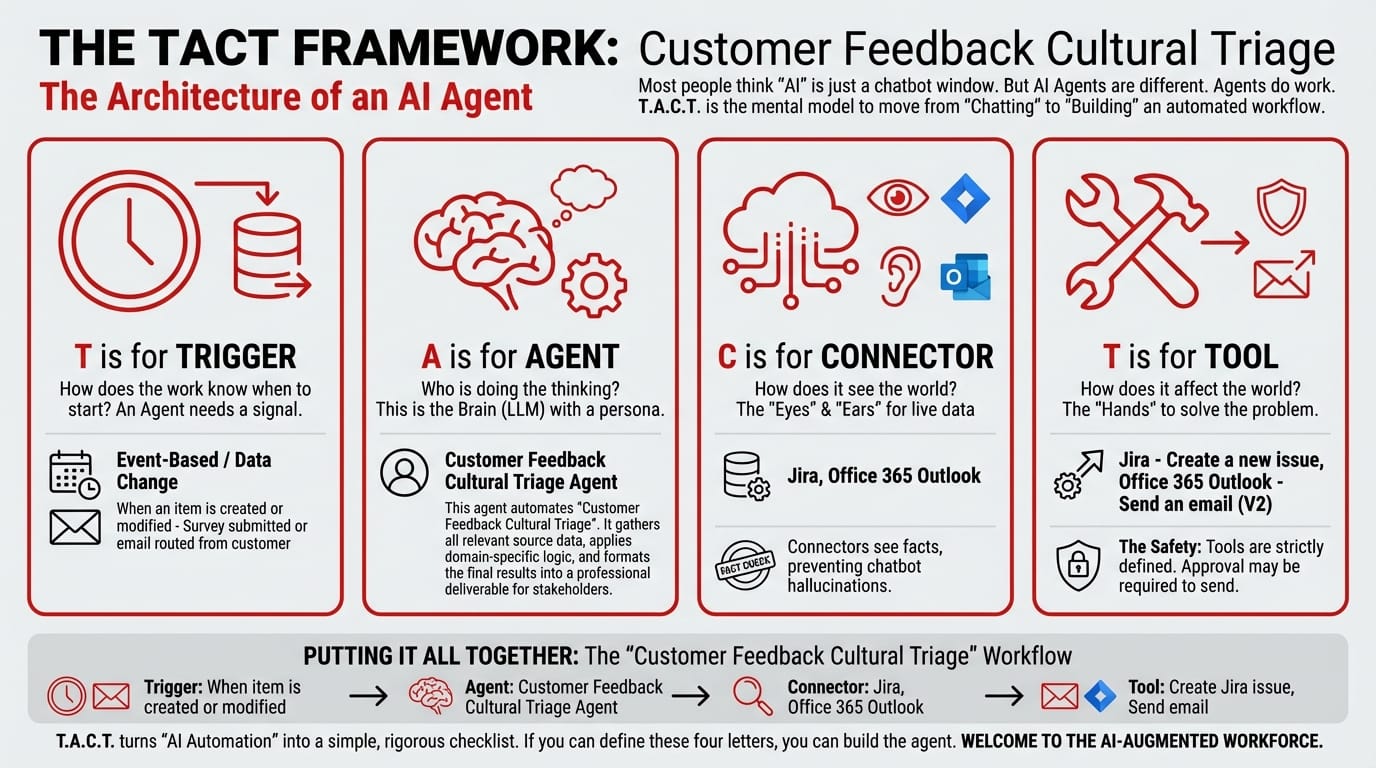
The Solution: Intelligent Cultural Triage via T.A.C.T.
T — Trigger: Event-Based (Feedback Received)
Trigger: When an item is created or modified
Configuration: Survey submitted or email routed from customer
Every piece of customer feedback — whether from a survey, a support email, or a CRM form — triggers the triage pipeline automatically.
A — Agent: Customer Feedback Cultural Triage (Orchestrator Type)
The agent runs three analytical stages before a ticket is created:
Stage 1 — Sentiment Analyzer: Standard sentiment scoring (positive/negative/neutral) plus emotional intensity measurement. This is the baseline — necessary but not sufficient.
Stage 2 — Cultural Context Evaluator: This is the breakthrough. The evaluator applies Hofstede's cultural dimensions to the feedback, considering the customer's market of origin:
- Power Distance: Is the customer likely to express frustration directly, or through indirect cues?
- Individualism vs. Collectivism: Is the complaint about personal experience or organizational failure?
- Uncertainty Avoidance: Does the customer need reassurance, or decisive action?
- Communication Style (Hall's High/Low Context): Is meaning in the explicit words, or between the lines?
Stage 3 — Ticketing Route Manager: Armed with both sentiment and cultural context, the agent creates a Jira ticket with a culturally informed severity assessment — not just a raw sentiment score, but an explanation of why the feedback should be taken more (or less) seriously than a surface reading suggests.
System Prompt:
You are a Customer Feedback Cultural Triage agent. Your workflow:
- Collect Input Data: Gather all relevant source data, documents, and information.
- Consolidate & Structure: Organize and standardize the collected data.
- Analyze & Process: Provide intelligent ticketing. Instead of just forwarding an angry email, append a cultural psychological breakdown for the support staff inside the Jira ticket.
- Validate Results: Review the processed output for accuracy.
- Distribute Output: Format the final results and share with stakeholders.
C — Connectors & T — Tools
| Connector | Role |
|---|---|
| Jira | Create culturally informed support tickets |
| Office 365 Outlook | Receive and route customer feedback emails |
| Tool | Function |
|---|---|
| Jira – Create a new issue | Generates a ticket with sentiment + cultural context appended |
| Office 365 Outlook – Send an email (V2) | Sends acknowledgment to customer, routes internal notification |
What the Support Team Actually Sees
Here's what a Jira ticket looks like without cultural triage:
Ticket: SUP-4421 Customer: Tanaka-san (Tokyo) Message: "I am somewhat disappointed with the delivery timeline." Sentiment: 🟡 Mild Negative Priority: Low
Here's the same ticket with the Cultural Triage Agent:
Ticket: SUP-4421 Customer: Tanaka-san (Tokyo) Message: "I am somewhat disappointed with the delivery timeline."
Sentiment Analysis: 🟡 Mild Negative (word-level)
Cultural Context Assessment: - Market: Japan (High Power Distance, High Uncertainty Avoidance, Collectivist) - Communication Style: High-context, indirect - Interpretation: "Somewhat disappointed" in Japanese business communication typically signals significant dissatisfaction. The use of understatement reflects cultural norms around indirect expression, not mild concern. - Adjusted Severity: 🔴 High — This customer is likely deeply frustrated and may be evaluating whether to continue the business relationship.
Recommended Action: Senior account manager follow-up within 24 hours. Personal outreach (phone preferred over email) recommended. Offer concrete timeline commitment rather than generic apology.
Priority: High
The support agent doesn't need a master's degree in cross-cultural communication. The triage agent added the context directly into the ticket.
The Results: What Changed After Deployment
After deploying the Cultural Triage Agent across the APAC support team:
- Escalation rate dropped from 40% to 24% — within 5% of the global average
- First-contact resolution improved by 18% — agents had better context on their first response
- Customer retention in the Japanese market improved by 11% — previously "quiet exits" were now caught early
The agent didn't replace the support team. It gave them cultural intelligence they didn't have — woven directly into their existing Jira workflow.
Close the gap in your operations.
Get immediate access to the full JSON schema for this workflow. By subscribing to the Library, you can copy and paste this architecture directly into Microsoft Copilot Studio, M365 Workflows (Frontier) Agent, or Google Workspace Studio in minutes.
⚠️ The price increases by $100 on the first Thursday of next month.
Every month, we add 4 new agentic workflows to the Library. Because the Library's value constantly grows, the price to access it increases every month. Get access today for $380/year to secure all 16 current schemas—and lock in your rate before the next price hike.