
Why Manual Directors' Fee Reconciliation Is a Ticking Compliance Time Bomb (And How agentic AI Defuses It)
You've been told spreadsheets are "good enough" for quarterly fee calculations. Here's why that belief is costing you accuracy, audit readiness, and sleep.
You've been told spreadsheets are "good enough" for quarterly fee calculations. Here's why that belief is costing you accuracy, audit readiness, and sleep.
The Lie You've Been Sold
Every quarter, someone on your corporate secretarial team opens a spreadsheet, cross-references board meeting attendance logs, applies tiered fee schedules, calculates pro-rated amounts, and produces a reconciliation report.
And every quarter, you tell yourself: "This is fine. We've always done it this way."
It's not fine.
Here's what's actually happening:
- Attendance data lives in three places. SharePoint meeting records, email confirmations, and sometimes a separate HR calendar. Nobody is 100% sure which is the source of truth.
- Fee schedules have exceptions nobody remembers. That director who was appointed mid-quarter? The one with a different fee tier for committee work versus full board meetings? Your spreadsheet doesn't enforce those rules — you do, from memory.
- Nobody checks last quarter's numbers against this quarter's. If the total suddenly jumps 15%, does anyone notice before it goes to finance? Or does the anomaly slip through because everyone assumes the spreadsheet is correct?
The truth you need to hear: a chatbot can't fix this. You can't paste fee schedules into ChatGPT and expect accuracy. It doesn't know your attendance records, your tiered structures, or your historical baselines. It will hallucinate a plausible-looking number that passes the eye test — until the auditors arrive.
What you need is an autonomous financial reconciliation engine that runs itself, enforces the rules, and flags its own errors.
Get immediate access to the full JSON schema for this workflow.
The Agentic Alternative: A Self-Auditing Fee Engine
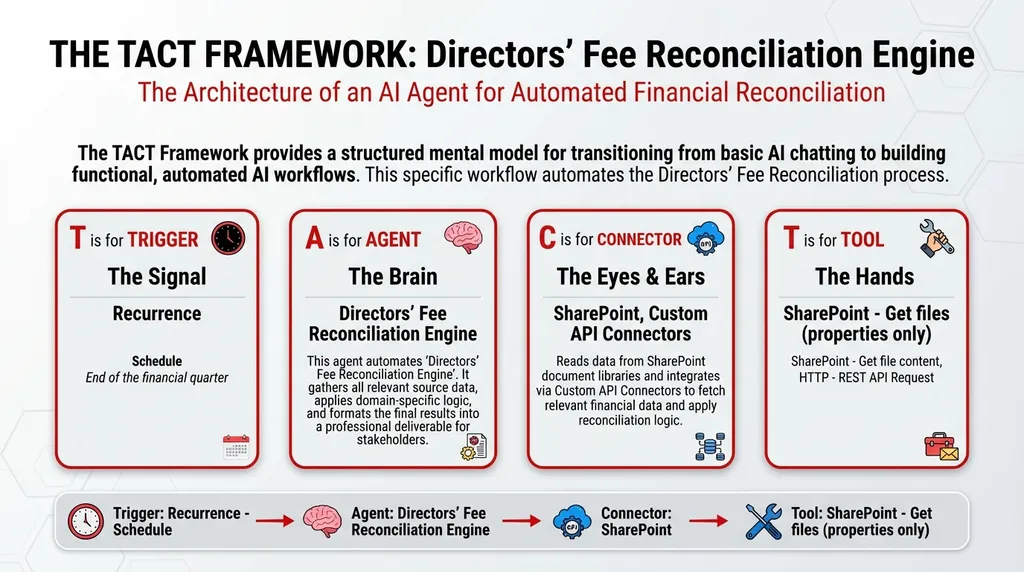
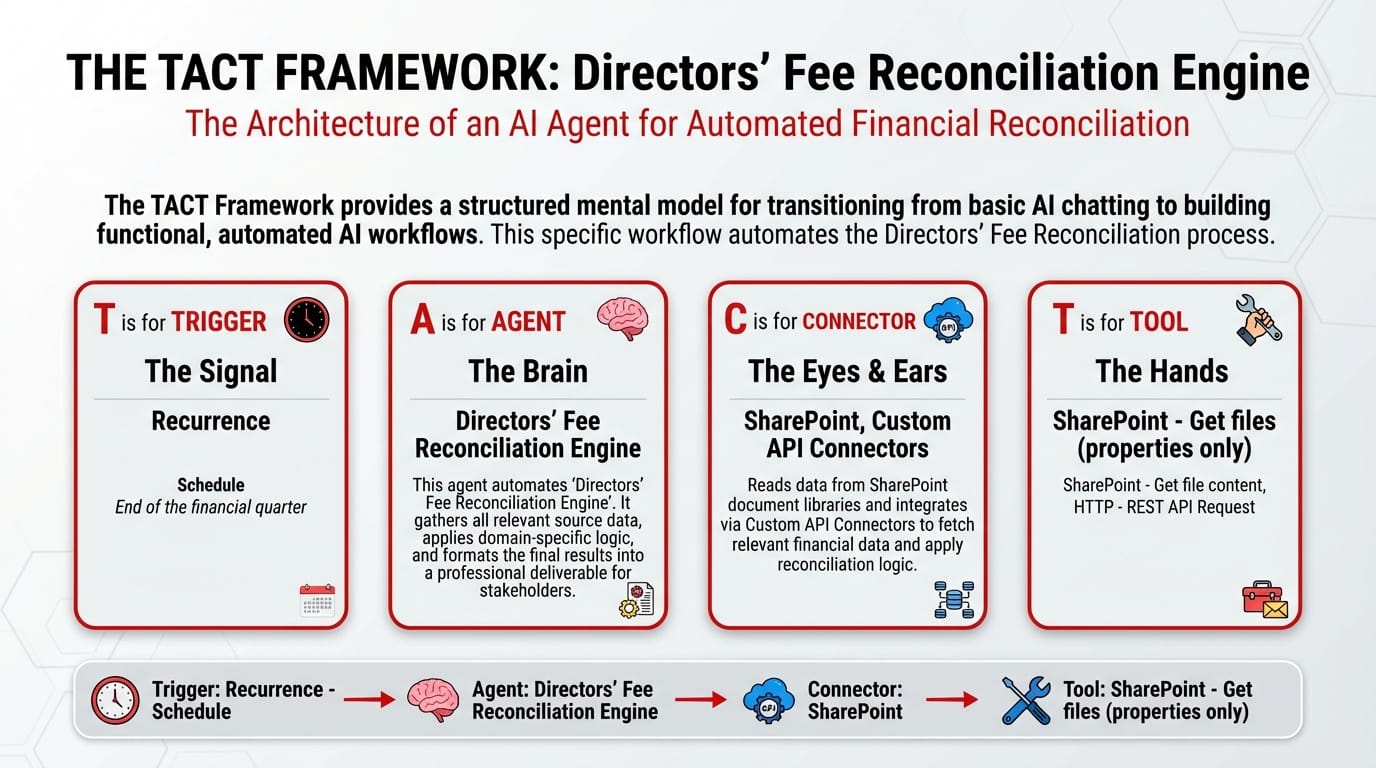
Using the T.A.C.T. Framework, we built a workflow that eliminates every failure point described above. Here's the architecture — and why each component exists.
T — Trigger: Recurrence Schedule (End of Financial Quarter)
The engine runs on a time-based trigger — configured to execute at the close of every financial quarter.
This is the myth-busting moment: you don't need to remember to reconcile fees. You don't need to block out a day on your calendar. The system fires on schedule, whether you're at your desk, on leave, or asleep.
The automation starts before the human even thinks about it.
A — Agent: Directors' Fee Reconciliation Engine
The agent operates as a Knowledge-type processor with a three-stage pipeline that goes far beyond simple calculation:
System Prompt:
You are a Directors' Fee Reconciliation Engine. Your workflow:
- Collect Input Data: Gather all relevant source data, documents, and information.
- Consolidate & Structure: Organize and standardize the collected data.
- Analyze & Process: Execute an autonomous, time-triggered financial workflow ensuring strict adherence to fee schedules over multiple disparate data sources.
- Validate Results: Review the processed output for accuracy.
- Distribute Output: Format the final results and share with stakeholders.
The critical innovation is in Step 4: self-reflection. The agent doesn't just calculate and deliver. It compares its output against the previous quarter's reconciliation report. If a director's fee changes by more than a configurable threshold (say, 10%), the agent flags the anomaly for human review instead of silently pushing it through.
This is what separates an agentic workflow from a macro. The agent questions its own output.
C — Connectors: SharePoint + Finance System API
| Connector | Role |
|---|---|
| SharePoint | Reads meeting attendance logs, fee schedule documents, and historical reconciliation reports |
| Custom API Connectors | Interfaces with the finance/ERP system for payment validation and ledger updates |
By connecting directly to SharePoint and your finance system, the agent eliminates the "three sources of truth" problem. It reads from the canonical attendance record and the official fee schedule. There is one pipeline, one source, one reconciliation.
T — Tools: Retrieval, Calculation, and Anomaly Detection
| Tool | Purpose |
|---|---|
| SharePoint – Get files (properties only) | Retrieves the list of attendance logs and fee schedule files |
| SharePoint – Get file content | Downloads actual file data for parsing and calculation |
| HTTP – REST API Request | Sends calculated fee data to the finance system and retrieves historical baselines |
What the Output Actually Looks Like
No more spreadsheets forwarded over email with a "please check" subject line. The agent produces a structured, audit-ready reconciliation report:
Directors' Fee Reconciliation — Q3 FY2025
Generated: 1 October 2025 | Engine: TACT Fee Reconciliation v1.3
Director Meetings Attended Fee Tier Pro-Rated Fee Q2 Fee Δ (%) Status Sarah Tan (Chair) 4/4 Tier A – Full Board $12,000 $12,000 0% ✅ Consistent James Lim 3/4 Tier A – Full Board $9,000 $12,000 -25% ⚠️ Flagged: Missed 1 meeting Rachel Ng 4/4 Tier B – Committee $6,000 $6,000 0% ✅ Consistent Daniel Koh 2/4 Tier A – Full Board $6,000 $12,000 -50% 🔴 Anomaly: Appointed mid-quarter? Anomaly Summary: - Daniel Koh's fee dropped 50%. Agent recommends verifying appointment date and confirming mid-quarter pro-ration is correct. - James Lim missed 1 meeting — fee automatically pro-rated per Attendance Policy v3.2 (Section 4.1b).
The agent doesn't just present numbers. It explains its reasoning and flags where a human should verify.
The Three Myths This Workflow Destroys
Myth 1: "Spreadsheets are accurate enough." They're only as accurate as the human who fills them in at 6 PM on a Friday. The agent enforces fee-schedule logic programmatically — no manual tier lookups, no copy-paste errors.
Myth 2: "We'd notice if something was wrong." Would you? A 5% variance across 8 directors in a quarterly reconciliation? The agent catches it. Your spreadsheet doesn't.
Myth 3: "AI can't handle financial calculations reliably." A chatbot can't. An agentic workflow can — because it's not generating numbers from training data. It's computing them from your actual attendance records and fee schedules, then cross-checking against historical baselines.
📚 If this resonated, read these next: - The Complete Guide to Automating Multi-Jurisdictional Legal Compliance — another governance workflow for corporate secretaries - 5 Steps to Automating XBRL Financial Statement Reviews with AI — AI for financial accuracy - Stop Asking AI the Wrong Questions: The Copilot Prompt Optimizer — the place to start if you're new to agentic AI
Your finance team deserves better than spreadsheets.
Close the gap in your operations.
Get immediate access to the full JSON schema for this workflow. By subscribing to the Library, you can copy and paste this architecture directly into Microsoft Copilot Studio, M365 Workflows (Frontier) Agent, or Google Workspace Studio in minutes.
⚠️ The price increases by $100 on the first Thursday of next month.
Every month, we add 4 new agentic workflows to the Library. Because the Library's value constantly grows, the price to access it increases every month. Get access today for $380/year to secure all 16 current schemas—and lock in your rate before the next price hike.